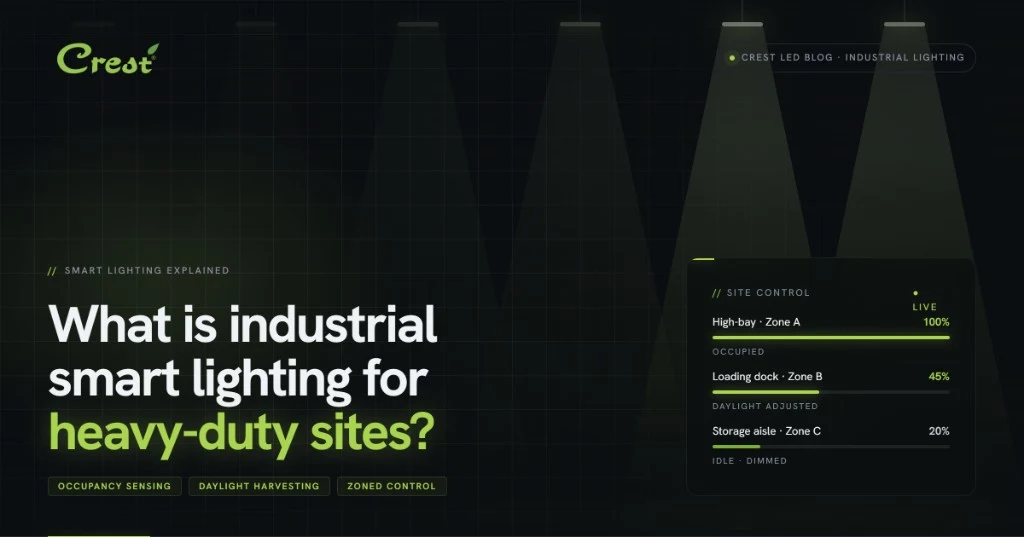
What is industrial smart lighting for heavy-duty sites?
Definitions first — what "smart" means for HSE and procurement teams specifying lighting on heavy-duty sites.
Look through almost any industrial lighting quotation today and the word "smart" appears somewhere. It can mean a fixture with a simple dimming input, a fully networked system reporting to a control room, or little more than a sticker on the box. For HSE managers and procurement teams buying for heavy duty and hazardous operations, that vagueness is a risk in itself, because the decisions made at specification stage determine how safely and reliably a site can be lit for the next ten years.
This article explains what industrial smart lighting systems actually are, what each layer of a system does, and which questions separate a dependable system from a marketing label. It is a definitions-first guide, and where a topic deserves deeper treatment we point to a companion article.
What Industrial Smart Lighting Systems Are, and What They Are Not
An industrial smart lighting system is a lighting installation where fixtures can be monitored, controlled, or both, and where that information can be used without someone physically walking the site. Industrial lighting automation is the part where the system acts on its own — switching, dimming, or flagging a fault according to rules such as schedules, occupancy, daylight levels, or detected failures.
It is not simply an LED fixture. A good LED fixture saves energy compared with older technology, but on its own it does not report its status or respond to conditions. It is also not a single product. A smart system is a stack of layers, and a weakness in any one of them limits what the others can deliver.
The Layers of a Smart Lighting System in Plain Terms
Fixtures and drivers. This is the foundation. The LED driver converts incoming power into the current the LEDs need, and it is usually the first component to fail when power quality is poor. Every layer above depends on this one surviving. Our guide to power surge protection for industrial smart lighting explains why drivers are the weak point.
Controls. The logic that decides what fixtures do. Control can be local, with a controller managing one zone, or centralised, with a platform managing many zones. Dimming and communication commonly use interfaces such as 0 to 10V or DALI, so it is worth confirming which one a proposed system uses.
Sensors. Occupancy sensors, daylight sensors, temperature sensors, and in some systems emergency lighting battery status. Each gives the system information to act on. Remote monitoring and sensor integration means those readings, along with fixture status and faults, travel back to a place where people can see them.
Communications. Wired or wireless links between fixtures, controllers, and gateways. Wireless reduces cabling but depends on signal reliability around heavy machinery, steel structures, and long distances. Wired links are more predictable but cost more to retrofit.
The supervisory layer. A dashboard, a building management system, or SCADA. This is where information becomes useful to operators instead of staying buried in the system.
SCADA Integration: What It Means and What to Ask
SCADA, short for supervisory control and data acquisition, is how many industrial sites monitor and control plant systems from a central point. SCADA integration for lighting means that lighting status, faults, and energy data appear in the same environment operators already use for other utilities, rather than in a separate dashboard that nobody checks.
When a supplier says their system integrates with SCADA, these are the questions that turn that statement into something verifiable:
- Which protocol does the lighting system use to communicate? Industrial sites commonly rely on protocols such as Modbus, OPC UA, or BACnet, so ask for the supported protocols in writing.
- What data is actually available? Fixture status, fault codes, and energy use are very different from a single "system healthy" flag.
- Who is responsible for the integration work — the lighting supplier, your engineering team, or a third party?
- How is the lighting network secured, and is it separated from the main plant network?
- What happens to the lighting if the connection to SCADA is lost?
Why Heavy Duty and Oil and Gas Sites Raise the Standard
Heavy duty sites share conditions that punish ordinary lighting: dust, moisture, washdown, corrosive atmospheres, vibration, wide temperature swings, and long gaps between maintenance visits. Oil and gas operations add classified hazardous areas, remote or offshore locations where every maintenance trip is expensive, and emergency lighting that is safety critical.
Three consequences follow for specification:
Environmental ratings must match the site. Ingress protection ratings for dust and water, such as the IP65 and IP66 ratings listed across Crest's tri-proof lights and flood lights, and impact ratings such as the IK10 listed on Crest's padel court lights, should be confirmed against the real installation conditions rather than assumed.
Hazardous zones need certified equipment. A smart feature does not change this. Every fixture, sensor, and control component inside a classified zone needs suitable explosion protection certification, or must be located outside the zone. This is covered in detail in A Beginner's Guide to Hazardous Area Smart Lighting and How to Choose Smart Lighting for Hazardous Zones.
Access cost raises the value of remote monitoring. When a fixture sits at height, offshore, or in a permit-controlled area, knowing that it failed — and why — before sending a crew changes the cost of every repair.
Reliability Criteria That Actually Predict Performance
Reliability is where a smart lighting evaluation is won or lost, and it needs to be assessed for the fixture and the control layer separately.
- Lumen maintenance. How much brightness remains over time, usually expressed as L70, L80, or L90 at a stated number of hours. Projections should come from a recognised method such as TM-21 using LM-80 test data. Several models in Crest's highbay range list 50,000 hours at L80 or L90.
- Driver quality and surge tolerance. Ask for tested figures rather than general statements, especially on grids with frequent voltage events. See also The Complete Guide to Surge-Resilient Smart Lighting.
- Thermal performance. In situ temperature measurement shows how hot components actually run inside a working fixture, which strongly influences lifespan. Crest's certifications page lists ISTMT testing among its test standards.
- Operating temperature range. Confirm it covers the real extremes of your site, not an average.
- Control layer behaviour. If communication fails, lights should stay on and revert to a local default. Ask for this in writing.
- Warranty scope. A 3, 5, or 10 year warranty only means something if it covers drivers and electronics as well as the LED chips.
- Documentation. Certificates and test reports for the exact model being quoted, not for a product family in general.
How Smart Lighting Supports Safer Procurement Decisions
For HSE managers, the value of a smart lighting system is largely about evidence. Remote monitoring can mean fewer people entering hazardous or permit-controlled areas just to find out whether a fixture has failed. Event logs create a documented record of when a lighting fault occurred and how quickly it was addressed, which is useful during incident reviews and audits.
For procurement teams, the same framework turns a comparison of quotations into a comparison of verified criteria rather than marketing claims. It also helps to know the warning signs:
- "Smart ready" fixtures with no documented protocol or integration details
- Certificates that cover a product family rather than the exact model
- No clear answer on what happens when the control system fails
- Energy savings quoted as a fixed percentage with no site data behind it
- Suitability for hazardous areas implied from an IP rating alone
Energy Efficiency and Savings: Setting Realistic Expectations
Energy savings from an industrial lighting upgrade come from two sources. The first is the move to efficient LED fixtures. The second is control-driven savings from scheduling, dimming, and occupancy response. It matters to know which one a quoted figure refers to.
Crest's documented results are LED retrofit results. At Lotte Akhtar Beverages, a retrofit of the production floor reduced energy consumption by 50 percent compared with the legacy fluorescent system, saved more than 7 million PKR per year in lighting electricity, and paid back in 18 months. At Big Bird Foods, an upgrade to sealed, food-grade fixtures across 2,277 luminaires cut lighting energy and maintenance load by half. At CBD Kalma Chowk, a street lighting corridor project raised night-time lux by 90 percent across a 2 kilometre stretch while lowering the energy and maintenance load. You can read the full details on our projects and clients pages.
Those results come from the LED fixtures themselves, not from smart controls. Controls can add further savings through scheduling, dimming, and occupancy response, but how much depends heavily on the site, so ask for a site-specific estimate instead of accepting a generic percentage.
A Short Framework for Smart Lighting System Selection
- Document the environment and any hazardous classification. Dust, moisture, corrosion, temperature range, and zone classification come first.
- Decide what actually needs monitoring and automation. Not every zone needs the same level of control, and unnecessary complexity adds cost and failure points.
- Choose the controls architecture. Local or centralised, wired or wireless, and where the control equipment will physically sit.
- Confirm integration. Protocols, data availability, ownership of the integration work, and network security.
- Verify certification and reliability evidence for the exact models. Request certificates, test reports, and warranty terms in writing.
- Compare total cost of ownership. Include energy, maintenance, downtime, and warranty, not just the purchase price.
Where Crest Fits In
Crest LED has manufactured industrial lighting in Lahore since 1996, as described on our About page, with ISO 9001 certified production and warranty coverage from 3 to 10 years depending on series. For heavy duty sites, the relevant range includes highbay lights, tri-proof lights, flood lights, street lights, and high mast lights, and our industries application page shows how they fit together on a site.
It is worth being direct about scope. Smart control features such as remote monitoring, sensor integration, and SCADA connectivity are not currently a confirmed part of Crest's product range, and our published certifications do not include ATEX or IECEx explosion protection. That means Crest fixtures suit heavy duty areas that are not classified as hazardous, and they should not be installed inside classified zones, which matters on oil and gas sites. If your project mixes classified and unclassified areas, request a quote with your full requirements and our team will tell you plainly what we can supply and where a specialist supplier is the better choice.
Specifying lighting for a heavy-duty or industrial site? Browse the industrial range, or request a quote with your environment and classification details.